

How to Identify & Get Rid of Argentine Ants
My Termite Company treats Argentine ant colonies across Los Angeles, the most common ant problem we see. This page covers how to identify Argentine ants, why the species forms colonies spanning hundreds of miles along the California coast, where it nests, what draws it indoors, and how to get rid of it for good. My Termite Company has served Los Angeles since 2008 under California SPCB License #7487. If ants are trailing across your kitchen counter right now, call (818) 940-0203 for pricing. See our full guide to ant species found in Los Angeles for other ant types.
What Are Argentine Ants
Argentine ants are the single most common ant found in and around California homes and gardens, according to the University of California Integrated Pest Management Program. The scientific name is Linepithema humile, and the species originated in subtropical regions of South America, specifically Argentina, Brazil, Paraguay, and Uruguay, before spreading worldwide through plant shipments and crate transport.
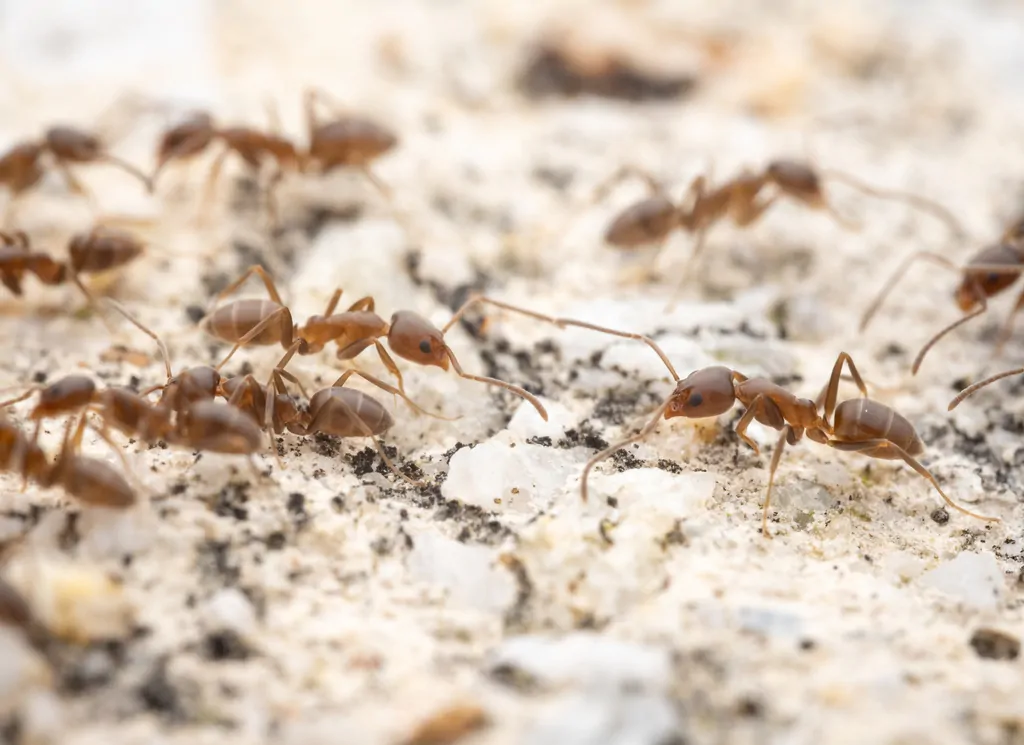
Workers measure about 1/8 inch long and run light to dark brown, with a faint musty smell released when crushed. A colony holds thousands to millions of workers and several queens, far more than most native California ant species carry. The nickname sugar ant gets applied to Argentine ants because of their strong attraction to sweets, though the same informal name sometimes applies to other small brown ants too.
Los Angeles sits well within the climate range where the species thrives year round, with activity continuing through the mild winter months rather than pausing for a true dormant season.
How to Identify Argentine Ants
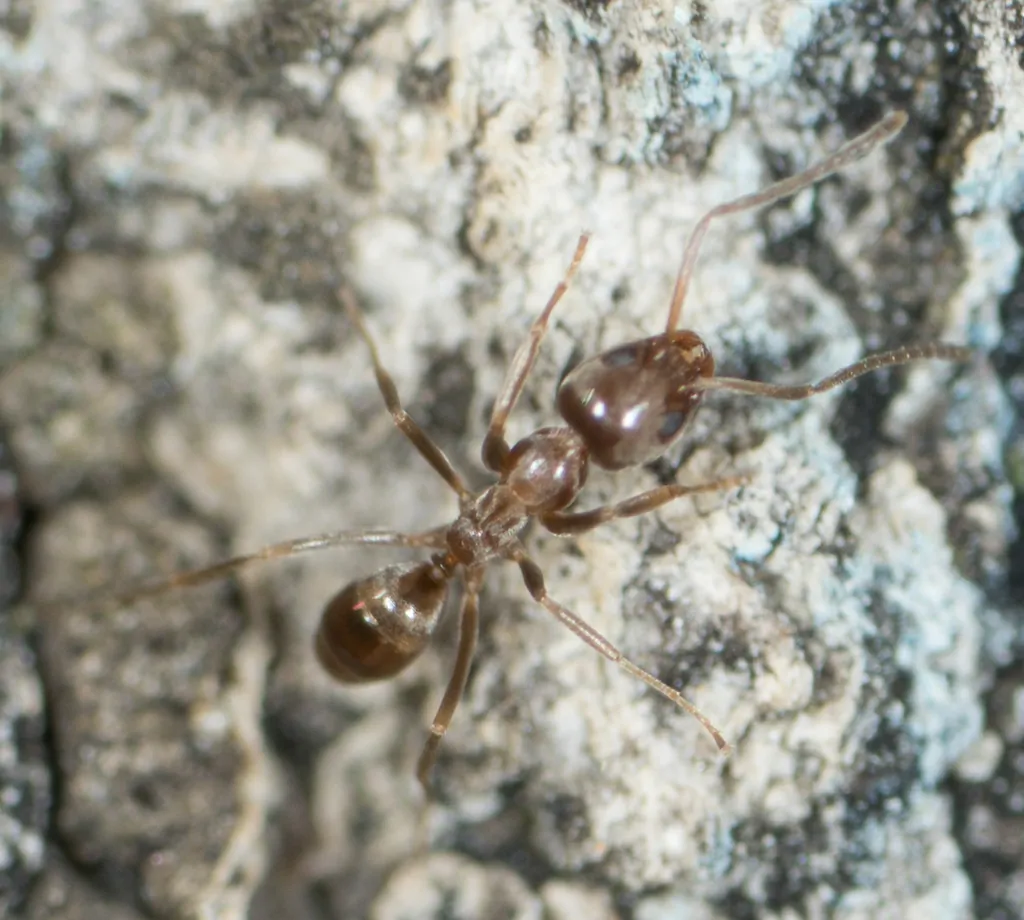
Identify an Argentine ant by three things together, a uniform light to dark brown color, a single node at the waist, and workers trailing in long, steady lines rather than scattering individually. A crushed worker gives off a faint musty odor, weaker than the sharp rotten coconut smell of an odorous house ant.
How Big Are Argentine Ants
Workers measure about 1/8 inch long, with little size variation between individuals in the same colony. This makes Argentine ants slightly larger than ghost ants and pharaoh ants, and noticeably smaller than carpenter ants, which run over 1/2 inch.
What Color Are Argentine Ants
Color ranges from light to dark brown across the body, without the two tone pattern seen in ghost ants or the near black shade of odorous house ants. The uniform brown color paired with a single node waist works as the fastest way to rule out a lookalike species.
Argentine Ants vs Look Alike Ants
| Trait | Argentine Ant | Odorous House Ant | Pavement Ant | Carpenter Ant |
|---|---|---|---|---|
| Size | About 1/8 inch | 1/16 to 1/8 inch | 1/8 to 1/5 inch | 1/4 to 1/2 inch or larger |
| Color | Light to dark brown | Dark brown to shiny black | Dark brown to black, lighter legs | Black, red and black, or solid red depending on species |
| Waist (node) | One node | One node, hard to see | One node, with two ridges on the thorax | One node |
| Distinguishing feature | Long steady trails, faint musty smell | Strong rotten coconut smell when crushed | Nests under sidewalk cracks and slabs | Leaves sawdust like frass, hollow sound in wood |
Send us a close up photo of the trail and we confirm the species before you buy the wrong bait.
The Supercolony Stretching Along the California Coast
A colony of Argentine ants in San Diego does not fight a colony near San Francisco. It cooperates with it. David Holway, a biology researcher at UC San Diego, studied this behavior and found Argentine ant populations across hundreds of miles of the California coast share chemical recognition cues and treat each other as one colony rather than rivals, a structure researchers call a supercolony.
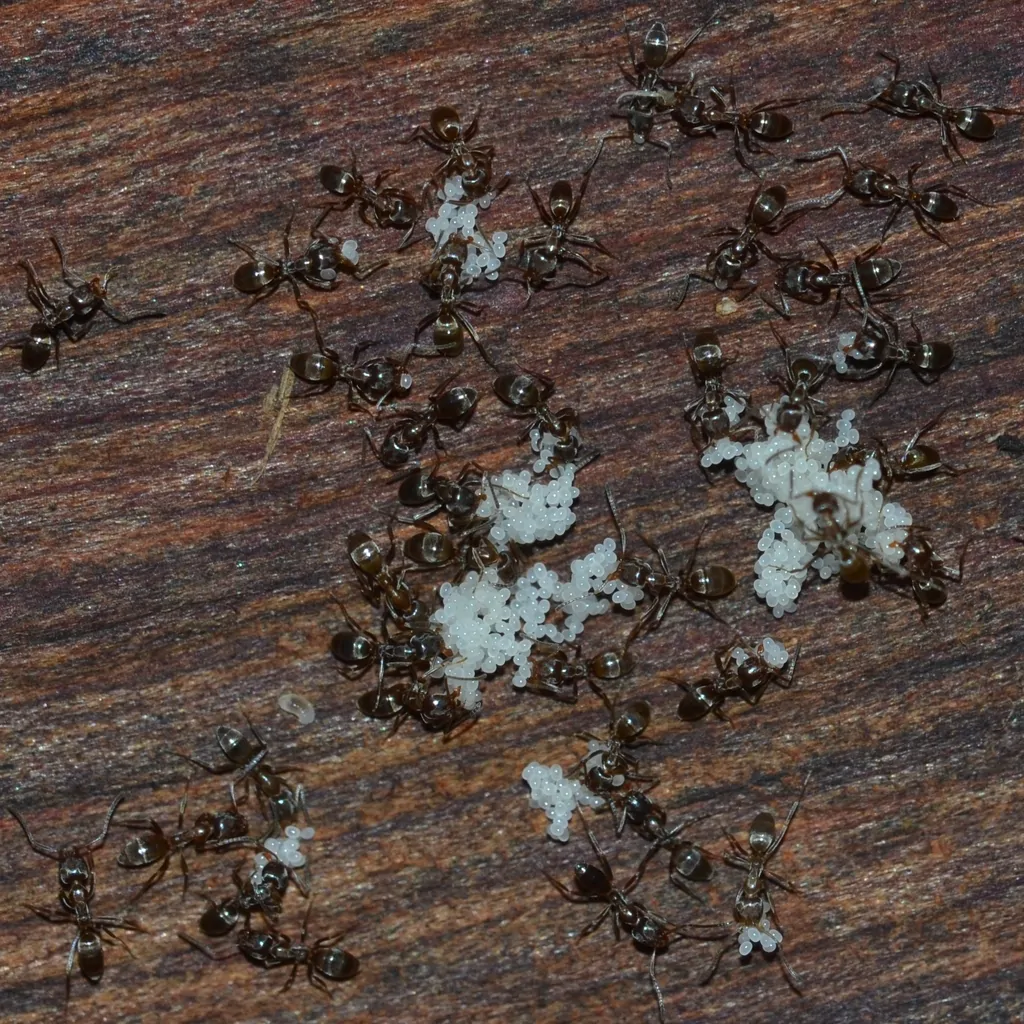
This matters for how the species behaves in your yard. Most native ant species fight neighboring colonies over territory, a natural limit on how large any one colony gets. Argentine ants skip this check entirely. UC Davis pest management data places a single Argentine ant colony anywhere from several thousand to well over a million workers, spread across many interconnected nests rather than one central mound, compared to a typical carpenter ant colony, which tops out around several thousand workers in one nest. This difference in scale explains why an Argentine ant problem on one property often traces back to activity spreading in from neighboring yards rather than one isolated nest you treat once and finish.
Why Argentine Ants Invade Los Angeles Homes
A UCLA study of campus buildings found temperature, not rain, predicted indoor Argentine ant activity more strongly than rainfall did. Researchers Gilboa, Klotz, and Nonacs published the 2012 study after tracking Argentine ant infestation patterns across University of California Los Angeles buildings, pushing back on the common idea ants move indoors mainly to escape wet weather.
The same study found proximity to a water source as the strongest single predictor of which rooms in a building got infested. Rooms near a sink, a drinking fountain, or a leak saw far more activity than rooms without one, regardless of temperature or season.
For a Los Angeles home, this means a dripping outdoor faucet, an irrigation line, or a pet water bowl near the foundation pulls a trail indoors as reliably as a heat wave. Moving these water sources away from the exterior wall ranks among the most effective, and most overlooked, ways to reduce the pull toward your kitchen or bathroom.
Where Argentine Ants Nest
Argentine ants nest in shallow soil, often no deeper than 8 inches below the surface. Common sites include under mulch, beneath stones or pavers, along sidewalk edges, inside potted plants, and near irrigation lines and sprinkler heads where soil stays consistently moist.
Indoors, colonies rarely establish a true nest unless the structure offers both warmth and moisture, such as a wall void near a leaking pipe or a crawl space with a persistent damp spot. Most indoor activity you see comes from foraging workers traveling from an outdoor nest rather than ants living inside the walls, a key difference from species like carpenter ants, which excavate wood to nest directly in a structure.
What Causes Argentine Ants in Your House
Argentine ants enter a home chasing water first and food second. A property with a consistently damp foundation, an overwatered garden bed, or a leaking outdoor spigot gives a nearby colony a reason to send foraging trails toward the structure, and those trails extend indoors the moment they find an entry point such as a gap under a door or a crack in the foundation.
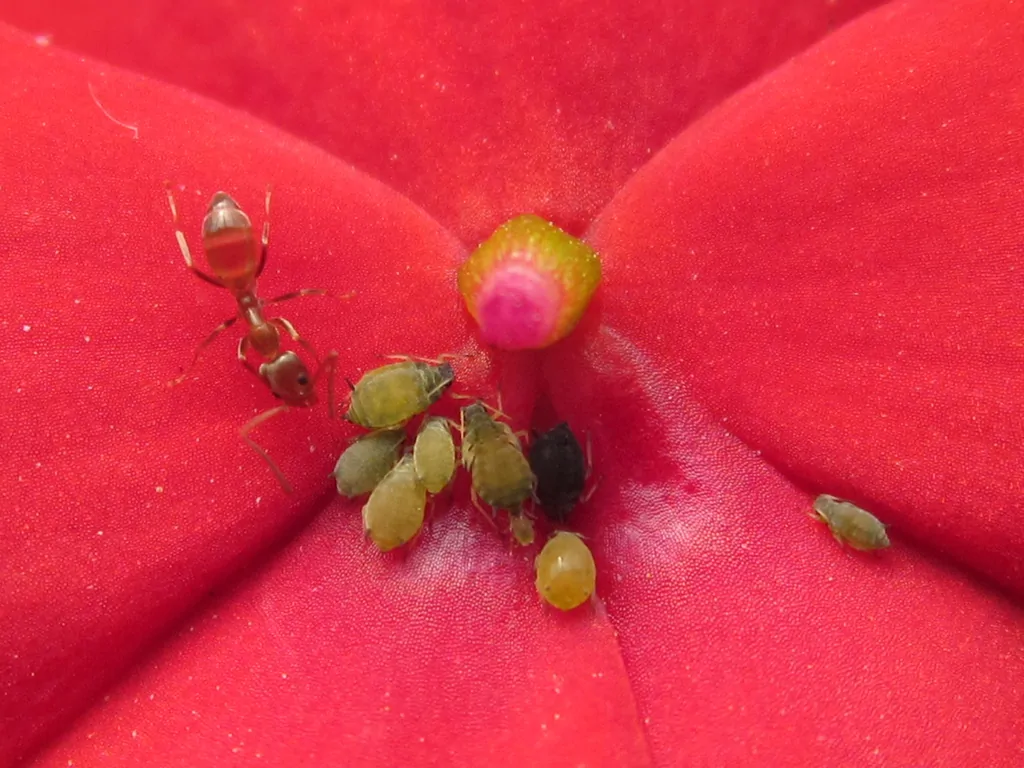
Food plays a secondary but still significant role. Argentine ants favor sweets and also tend aphids and other sap feeding insects on garden plants for the honeydew they produce, so a yard with an aphid problem indirectly feeds a colony already deciding your kitchen counter is worth investigating too.
Why Spray Often Makes It Worse
A disturbed Argentine ant trail often splits into more trails instead of disappearing. Spraying a visible line of ants with a store bought repellent kills the workers it touches but does nothing to the nest producing them, and the sudden disruption sometimes triggers budding, where part of the colony relocates to a new site nearby rather than staying put.
This is the same mechanism already documented on our Odorous House Ant page, and it applies directly here. Because an Argentine ant colony typically runs many interconnected nests across a supercolony network rather than one central nest, a spray scattering one group of workers rarely solves the underlying problem. It sometimes pushes activity into a new part of the structure, such as a wall void instead of a baseboard.
How to Get Rid of Argentine Ants
Move standing water away from your home before you treat a single ant.
- Fix leaking outdoor faucets, irrigation lines, and drainage issues near the foundation first, since water near the foundation is what pulls Argentine ant trails toward a house.
- Trim back vegetation and mulch touching the exterior wall, removing the moist, shaded conditions Argentine ants prefer for nesting close to a structure.
- Use a slow acting bait rather than a repellent spray, placed directly on an active trail, so foraging workers carry it back to the nest and share it with the queens.
- Seal visible entry points such as gaps under doors, utility line penetrations, and cracks in the foundation, after the bait has had time to work rather than before.
- Recheck bait placement every few days, since a colony this large often needs a sustained feeding period before activity noticeably drops.
DIY vs Professional Treatment for Argentine Ants
| Method | What It Targets | Where It Falls Short |
|---|---|---|
| Store bought repellent spray | Ants in view on contact | Leaves the nest untouched and sometimes triggers budding into a new site |
| Single location bait station | One active trail | Misses other nests feeding from the same supercolony network |
| Fixing moisture and food sources | The conditions drawing a colony toward the structure | Slows new activity but leaves nests already established nearby untouched |
| Professional inspection and treatment | The full trail network and multiple connected nests | Requires licensed bait products and trail mapping not available at a retail store |
A store bought spray kills the ants it touches and does nothing to a supercolony spread across the properties around you. A licensed technician maps the active trails and treats the nests feeding them.
Argentine Ant Treatment Cost in Los Angeles
Argentine ant treatment in Los Angeles follows the same pricing as our other general ant control work, since the treatment approach covers the species found on your property, not one price per ant type.
| Service | Typical Price Range |
|---|---|
| One time ant treatment | Call for pricing |
| Quarterly pest control plan, residential | $300 every 3 months, or $240 every 3 months with a yearly agreement |
| Quarterly pest control plan, apartment or condo | Call for pricing |
An on-site visit confirms the extent of the trail network on your property and gives you an exact price before any work begins.
Argentine Ant Control in Los Angeles, Our Process
My Termite Company handles Argentine ant calls in five steps, confirm the species, trace active trails to their source, apply a treatment matched to the size of the colony network, follow up on results, and recommend the moisture fixes needed to keep new trails from forming.
- We identify the ant species from your photos or an on site inspection, since several common Los Angeles ants resemble Argentine ants at a glance.
- We trace foraging trails back to their source, since an Argentine ant problem usually connects to more than one nest nearby.
- We apply a treatment matched to the scale of the colony, built to reach queens through normal foraging rather than only killing visible workers.
- We follow up after treatment to make sure activity has stopped.
- We recommend moisture and exclusion fixes to reduce the chance of a new trail forming from a neighboring property.
My Termite Company has served Los Angeles since 2008 under California SPCB License #7487, serving Los Angeles and the surrounding cities, including Pasadena, Burbank, Alhambra, Glendale, and Highland Park.
Frequently Asked Questions
Are Argentine ants the same as sugar ants?
The nickname sugar ant gets applied to Argentine ants because of their strong attraction to sweets, though the same informal name sometimes gets used for other small brown ants too. Argentine ants are the species most commonly meant by the term in Los Angeles.
What is a supercolony?
A supercolony is a network of Argentine ant nests spread across a wide area, cooperating instead of fighting, confirmed by UC San Diego research spanning hundreds of miles of the California coast.
Why do Argentine ants keep coming back after I spray them?
A spray kills visible workers but leaves the nest intact, and the disruption sometimes causes the colony to bud into a new nearby site instead of disappearing.
Do Argentine ants bite or sting?
They carry no stinger, and bites are rare and mild, noticed mainly when a nest gets directly disturbed.
Do you treat Argentine ants in apartments and businesses?
Yes. Our commercial pest control team treats Argentine ant activity in apartment buildings, offices, and other commercial properties across Los Angeles and nearby cities such as Pasadena and Burbank.
Get Rid of Argentine Ants Today
Call (818) 940-0203 for pricing or to schedule Argentine ant treatment in Los Angeles. Our technicians map the trail network, identify the nests feeding it, and treat the colony at its source, not only the ants crossing your counter.
