

Why Do Termites Suddenly Appear in Your House?
What looks like a sudden termite appearance is almost never sudden. When you first notice
termites, the colony has typically been active inside your home for 1 to 5 years. Termites are
cryptic. They live inside wood, beneath soil, and in hidden wall cavities. By the time they
become visible, the infestation is well established.
This guide explains the 7 specific triggers that cause termites to become visible and what
each one means for your home.
7 Reasons Termites Suddenly Appear in Your Los Angeles Home
Reason 1 – Termite Swarming Season: Nature’s Alarm Bell
Los Angeles drywood termites swarm primarily in late summer through early fall typically August through October usually in spring or after rainfall when warm temprature and high humidity signal the colone it’s time to expand. During a swarm, reproductive termites (called alates or swarmers) leave established colonies in large numbers to mate and start new colonies elsewhere.

You may see dozens to hundreds of flying termites near windows, lights, and vents. This is the
most common reason homeowners suddenly discover termites.
If you’re seeing flying termites inside or around your home, that’s not just a coincidence, it’s a warning. Swarming means there’s likely a mature colony nearby or even inside your house.
Signs to Watch For:
- Swarmers indoors: An established colony inside your walls is producing new reproductives. The infestation is active.
- Flying termites near light fixtures, windows, or doorways. Your home has gaps or cracks large enough for entry. Swarmers shed their wings immediately after landing, so you may find small piles of equal-length wings near windows.
- Discarded wings on floors, windowsills, or countertops
- Swarms appearing after rainstorms or on warm, humid days
When swarmers show up, it’s time to act fast. These termites don’t bite or eat wood, but they’re messengers of something much worse: a full-blown colony silently destroying your home from the inside.
Reason 2: Moisture from Plumbing Leaks or Rain
Subterranean termites need moisture to survive. A slow plumbing leak, condensation around an air conditioning unit, or poor drainage near your foundation creates ideal termite conditions.
Many LA homeowners discover termites while investigating a water-related issue because
the damage was already there.
Even drywood termites are attracted to wood that has softened from intermittent moisture exposure. Bathroom walls, kitchen cabinetry near the sink, and areas around roof leaks are common first discovery points.
Reason 3: Wood-to-Soil Contact
Where wood touches soil, subterranean termites have direct highway access into your home.
Common sites: wooden siding that extends to grade level, deck posts set in soil, door frames at or below grade, and landscaping timbers adjacent to the structure. If your home has any of
these, it is at higher risk for subterranean termite entry.
Reason 4: Cracks in the Foundation or Exterior Walls
Termites can squeeze through cracks as narrow as 1/32 of an inch. Foundation cracks from
settling, gaps around utility penetrations (electrical, plumbing, gas lines), and deteriorated
caulking around windows and door frames all provide entry points for both drywood and
subterranean termites.
Reason 5: Firewood or Lumber Stored Against the House
Stacking firewood against the exterior wall of your home is one of the fastest ways to introduce termites. Termites establish in the wood pile and move directly into the structure. The same applies to construction lumber stored on-site, wood chips, and mulch piled close to the foundation. Move all wood storage at least 20 feet from your home.
Reasons 6: Dead Trees, Stumps, or Old Fencing
A dead tree stump in your yard is a natural termite habitat. Once fully colonized, a stump colony expands outward through the soil. Your home becomes a natural next target, particularly if it is within 100 feet. Old wooden fences that connect your property to neighboring properties also serve as termite highways.
Reasons 7: A Neighbor Recently Had Termites Treated
This is more common than most homeowners realize. When a neighboring property undergoes fumigation, termites present in shared fencing, soil, or adjacent landscaping may migrate. Subterranean termites travel through soil and do not respect property lines. If a neighbor recently treated for termites, schedule an inspection for your own home.
What Attracts Termites to Your Specific House?
Beyond entry points, certain conditions make a home more attractive:
- Older construction with more weathered wood, gaps, and settled framing.
- Poor crawlspace ventilation creating persistent moisture.
- Softwood framing common in pre-1970 Los Angeles construction.
- Dense landscaping planted directly against the structure.
- Flat or low-slope roofs where wood components are exposed to pooling water.
- Attached garages with wood-frame walls that interface with the soil.
Why Termites Suddenly Appear?
Sometimes it feels like termites show up overnight—but their arrival usually follows a clear pattern.
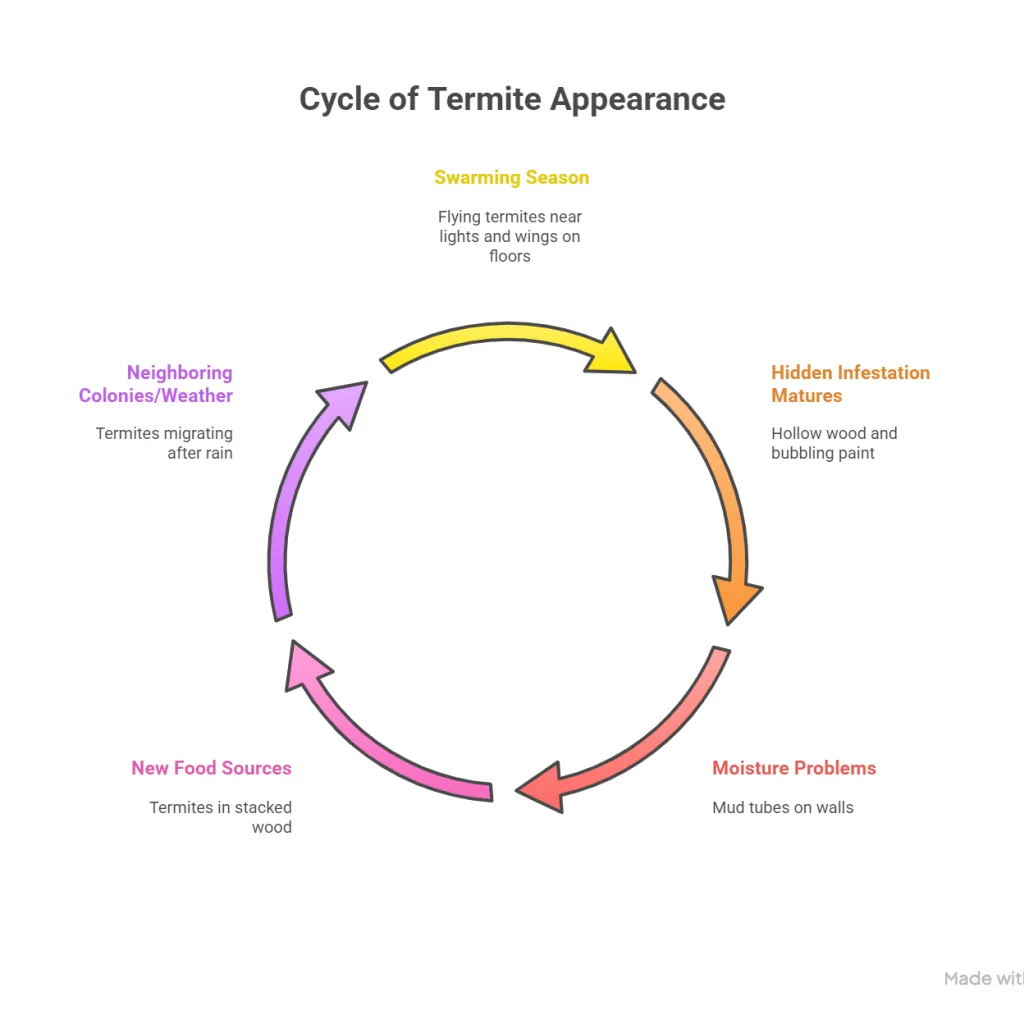
Here’s a quick breakdown of the most common reasons and what signs you’re likely to see:
| Reason | What You’ll See |
|---|---|
| Swarming season | Flying termites near lights, wings on floors, doorways and window frames |
| Hidden infestation matures | Hollow wood, jammed doors, bubbling paint |
| Moisture problems | Mud tubes on walls, increase in visible activity |
| New food sources | Termites in stacked firewood or construction wood |
| Neighboring colonies/weather | Termites migrating in after rain or warm temps |
What to Do When Termites Suddenly Appear
Do not spray visible termites with insecticide from a store. Surface sprays kill visible termites but drive the colony deeper into the wood, making treatment more difficult and sometimes masking the infestation during a subsequent inspection.
The correct steps:
- Photograph the termites or any damage you observe.
- Note the specific location like which room, which wall, whether they came from inside or
outside. - Do not disturb the area further.
- Schedule a professional termite inspection within 48 hours.
A licensed inspector will identify the species, locate the colony, assess the extent of the
infestation, and recommend the appropriate treatment whether spot treatment, heat
treatment, or full fumigation
What To Do When Termites Appear

It is important to stay observant and know what to do when you find termite activity.
Step 1 – Don’t Ignore the Signs
If you’re seeing wings, damaged wood, or termite droppings, take it seriously.
Termites won’t go away on their own, and the longer you wait, the worse the damage gets.
Ignoring the problem can turn a minor fix into thousands in structural repairs.
Step 2 – Call a Termite Expert Immediately
A professional inspection is the only way to know how bad the infestation really is.
Licensed termite pros can identify the colony source, the extent of the damage, and the best treatment plan—whether it’s localized treatment, fumigation, or wood repairs.
You’ll also get preventative tips to keep termites from coming back.
📞 In Los Angeles? Call My Termite Company at 818-940-0203 for a free consultation.
Termites Aren’t Random, They’re Reactive
Termites don’t appear out of nowhere. They respond to moisture, food sources, seasonal changes, and nearby colonies.
The good news? You can stop them before they cause real damage.
✔️ Know the signs
✔️ Fix moisture issues
✔️ Keep wood off the ground
✔️ Schedule regular inspections
Proactive care today = big savings tomorrow. 🏠
What My Termite Company Can Do For You
At My Termite Company, we help homeowners protect what matters most, their home, their investment, and their peace of mind.

What My Termite Company can for you:
Schedule an Inspection Today!

Click here to schedule an inspection today!
Rest assured you will be provided with expert guidance and a professional service!
