

What are Pavement Ants and How to Identify Them?
My Termite Company finds and removes pavement ant colonies across Los Angeles. This page covers how to identify pavement ants, why you see them fighting in large numbers on your driveway, whether they bite or sting, where they nest, and what our technicians do differently. My Termite Company has served Los Angeles since 2008 under California SPCB License #7487. If you keep finding small dark ants along your sidewalk, driveway, or kitchen counter, call (818) 940-0203 for pricing. See our full guide to ant species found in Los Angeles for other ant types.
What Are Pavement Ants
Pavement ants build their nests under the concrete surrounding your home. The scientific name is Tetramorium immigrans, a name entomologists assigned after genetic research split the species once known as Tetramorium caespitum into several separate ants across North America and Europe. Pavement ants rank among the most common ants reported indoors across the country, and Los Angeles gives them an especially large supply of concrete driveways, patios, and walkways to nest under.
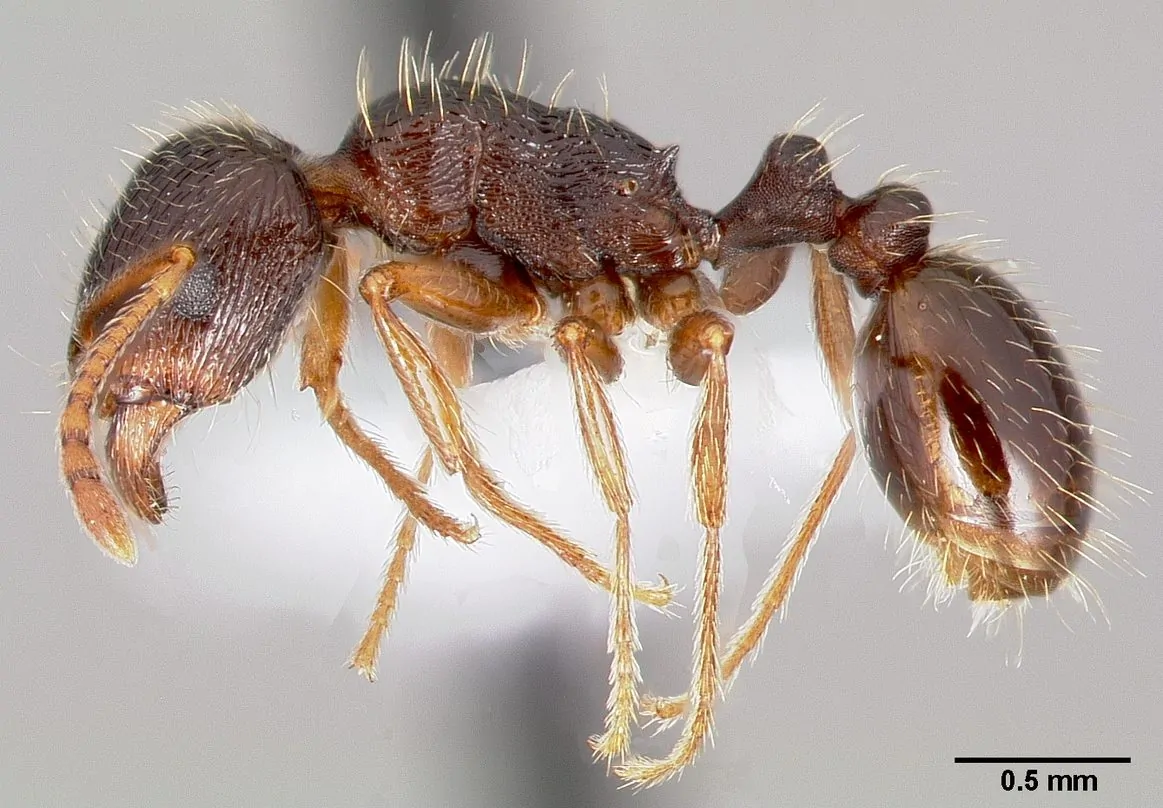
Workers measure about 1/8 inch long and run pale brown to dark brown or black, with legs and antennae lighter than the rest of the body. Under magnification, parallel grooves run across the head and thorax, and a small pair of spines sits on the back edge of the thorax. These ants feed on a wide range of food, including honeydew from sap feeding insects, soil dwelling insects, sweets, and grease, which is why a trail often runs straight into your kitchen.
How to Identify Pavement Ants
Identify a pavement ant by three things together, a size of about 1/8 inch, parallel grooves on the head and thorax, and a small pair of spines on the back. A hand lens or a close up phone photo usually brings all three into view.
How Big Are Pavement Ants
Workers run close to 1/8 inch long, in the same size range as odorous house ants and smaller than most carpenter ants. All workers in a pavement ant colony measure about the same size, with no separate major and minor worker castes.
What Color Are Pavement Ants
Color ranges from pale brown through dark brown to black, often with the legs and antennae a shade lighter than the body. A dark ant with grooved lines on its head, found marching along a sidewalk crack or driveway edge, is almost always a pavement ant.
Pavement Ants vs Look Alike Ants in Los Angeles
| Trait | Pavement Ant | Argentine Ant | Odorous House Ant | Carpenter Ant |
|---|---|---|---|---|
| Size | About 1/8 inch | About 1/8 inch | 1/16 to 1/8 inch | 1/4 to 1/2 inch or larger |
| Color | Pale brown to black | Light to dark brown | Dark brown to shiny black | Black, or black and red |
| Waist (node) | One node | One node | One node, hard to see | One node |
| Distinguishing feature | Grooved head and thorax, two small spines on the back | Smooth body, faint musty smell when crushed | Strong rotten coconut smell when crushed | Large size, smooth evenly rounded thorax profile |
Send us a close up photo of the ants on your sidewalk or driveway and we confirm the species before you buy the wrong bait.
Why You See Pavement Ants Fighting on Sidewalks
Those piles of dead ants covering your driveway in spring come from a territorial battle between two neighboring colonies. Pavement ant colonies defend fixed territories, and workers from rival colonies run into each other constantly while foraging along the same stretch of pavement.
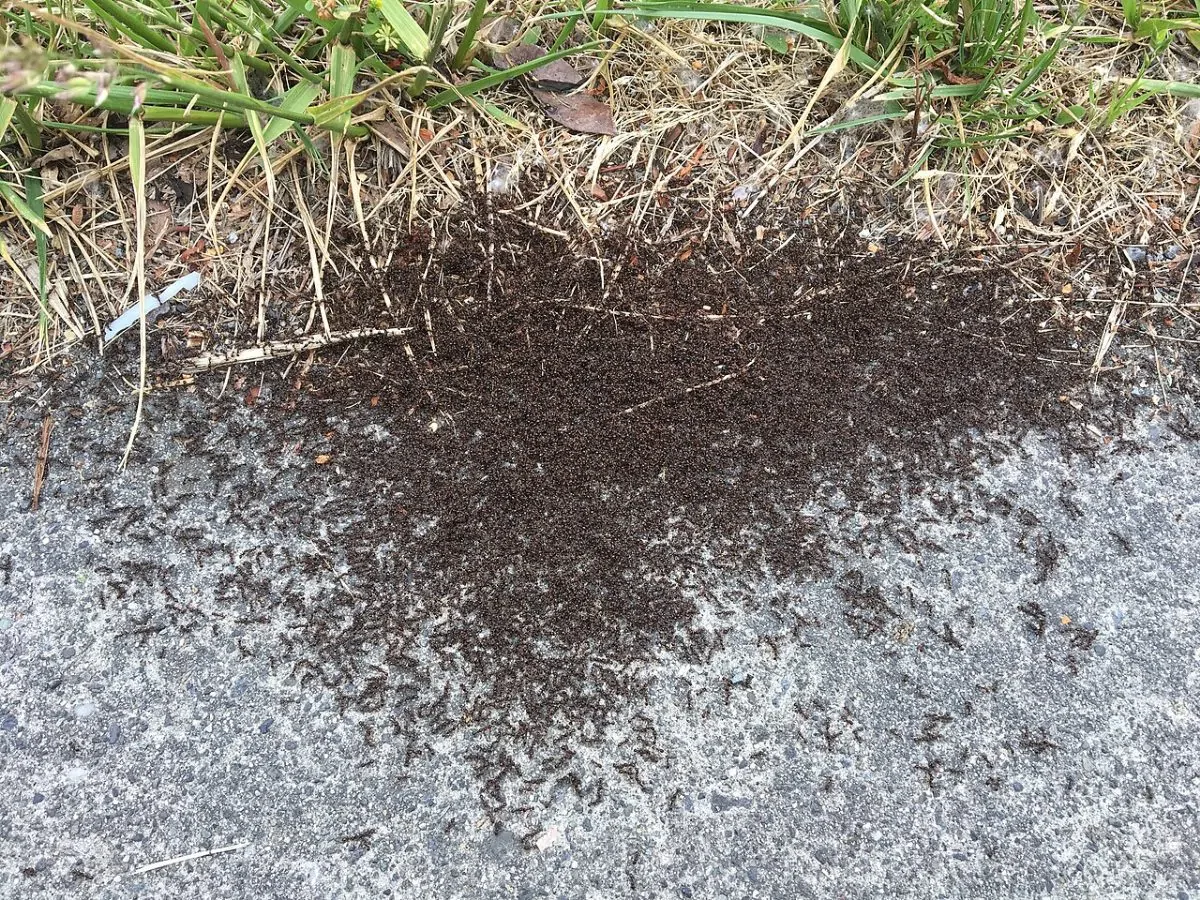
Entomologists at Ohio State University Extension describe these clashes as full scale battles rather than minor skirmishes. A colony expanding its territory pushes into ground a neighboring colony already claims, and the two sides fight it out on neutral pavement between the nests. The most intense fights happen when one colony raids another outright, and the defending colony throws every available worker into the fight. Ants on the winning side carry off the dead as food. None of this fighting threatens your home or your family. It signals two or more active colonies near your property, each one worth locating and treating on its own.
Do Pavement Ants Bite or Sting
Pavement ants carry a stinger, but it rarely breaks human skin. Washington State University Extension describes the species as carrying a stinger while rarely acting aggressively toward people, and Cornell’s integrated pest management program notes the stinger runs generally too weak to cause harm even when an ant attempts to use it.
In practice, a pavement ant bite or sting feels like little more than a brief pinch, if you notice it at all. The real cost of a pavement ant problem is nuisance and contamination, foraging trails across counters and pantry shelves, not a safety risk to people or pets.
Where Do Pavement Ants Nest in Los Angeles
Pavement ants nest under the sidewalks, driveways, and patios covering most Los Angeles properties. Outdoors, look for small mounds of displaced soil pushed up through cracks in concrete, along foundation edges, under landscaping stones, and beneath stacked materials sitting directly on the ground.
Los Angeles gives this species an unusually large amount of habitat to work with. Drought tolerant landscaping across the city has replaced lawn space with pavers, concrete patios, and gravel beds, and every seam and expansion joint in this hardscape gives a colony an entry point into the soil below. Indoors, pavement ants favor wall voids, spaces under flooring, and insulation near a water heater or furnace, where warmth and moisture stay steady through the year.
What Causes Pavement Ants in Your Home
Pavement ants enter a home chasing food, moisture, or a warm nesting spot during cooler months. An outdoor colony sends foraging workers along a pheromone trail, and once the trail leads to a reliable food source inside your house, the colony keeps using it.
Common causes include a slab crack or expansion joint running close to an exterior wall, mulch or soil piled against the foundation, spilled pet food, crumbs left on counters overnight, and gaps around doors, windows, or utility lines. Grease, meat, and sweet foods all attract pavement ants equally, so a kitchen with either type of food left out draws a trail equally fast.
Pavement Ant Colonies, How Big They Get
A single pavement ant colony holds 3,000 to 10,000 workers, far larger than most homeowners expect from an ant this small. Most colonies live under one queen, though larger, more established colonies sometimes support several queens at once.
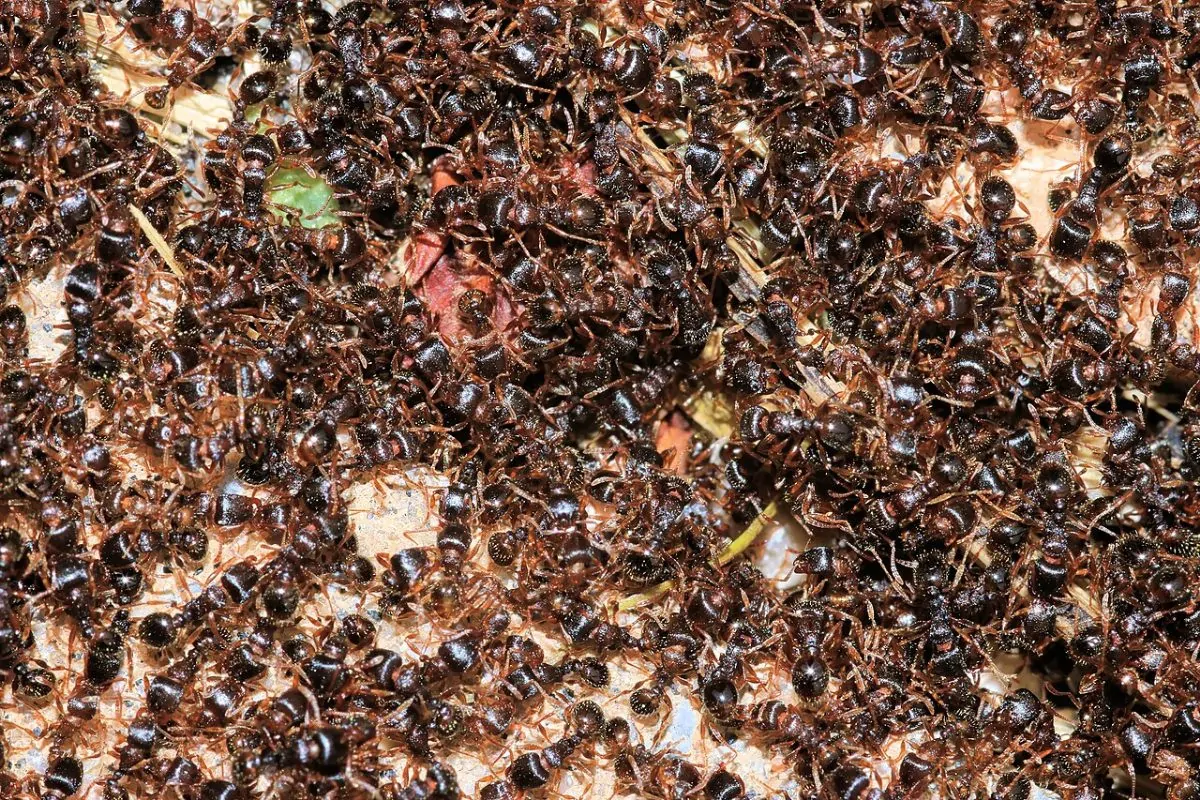
A colony this size explains why a few ants on your counter in the morning become a steady trail by evening. Workers forage mostly at night, with daytime activity picking up during spring and summer, and a strengthening pheromone trail recruits more workers to a food source the longer it stays available.
How to Get Rid of Pavement Ants
Trace the trail back to the nest before you treat anything, since killing foragers on your counter does nothing to the colony sending them.
- Watch the direction worker ants travel. Ants heading back toward the nest move in a straight, direct line and often carry a visibly swollen abdomen from a recent meal.
- Place a small amount of diluted honey or jam along the trail and follow the ants collecting it back to the entry point or nest.
- Choose a bait labeled specifically for pavement ants rather than a carpenter ant bait, since the two species respond to different food formulations and a mismatched bait gets ignored.
- Set bait directly on the active trail, not at the suspected nest entrance, and keep it fresh so workers keep carrying it back to the colony.
- Grade soil away from the foundation, clean gutters, and seal gaps around doors, windows, and utility lines to close off new entry points once activity drops.
DIY vs Professional Treatment for Pavement Ants
| Method | What It Targets | Where It Falls Short |
|---|---|---|
| Store bought repellent spray | Ants in view on contact | Leaves the colony under the concrete untouched and can scatter activity to a new spot |
| Carpenter ant bait used on pavement ants | Foragers carrying bait back to a nest | Wrong food formulation for this species, so workers often ignore it entirely |
| Sealing cracks and joints alone | Entry points into the structure | Does nothing to the nest feeding the trail outdoors |
| Removing moisture and food sources | The conditions drawing a colony indoors | Slows new activity but does not remove a nest already established under the pavement |
| Professional non repellent treatment | The nest and colony, through normal foraging behavior | Requires licensed products and nest location skills, not available at a retail store |
A store bought spray kills the ants it touches and leaves the colony underneath your driveway untouched. A licensed technician locates the nest and treats the colony producing the trail, not only the ants in view.
Pavement Ant Treatment Cost in Los Angeles
Pavement ant treatment in Los Angeles follows the same pricing as our other general ant control work, since the treatment approach covers the species found on your property, not one price per ant type.
| Service | Typical Price Range |
|---|---|
| One time ant treatment | Call for pricing |
| Quarterly pest control plan, residential | $300 every 3 months, or $240 every 3 months with a yearly agreement |
| Quarterly pest control plan, apartment or condo | Call for pricing |
An on-site visit confirms the species, locates the nests feeding the trail on your property, and gives you an exact price before any work begins.
Pavement Ant Control in Los Angeles, Our Process
My Termite Company removes pavement ants in five steps, identify the species and trace active trails, locate the nest or nests feeding them, apply a targeted non repellent treatment, follow up on results, and recommend the exclusion work needed to keep a new colony from moving in.
- We identify the ant species and inspect sidewalks, driveways, patios, and the foundation perimeter for nest signs.
- We trace foraging trails back to their nests, since pavement ant colonies are often several and spread across one property.
- We apply a non repellent treatment matched to pavement ant feeding behavior, carried back to the colony through normal foraging rather than killing only on contact.
- We follow up after treatment to make sure trail activity has stopped.
- We recommend sealing and moisture fixes to keep new colonies from establishing in the same cracks and joints.
My Termite Company has served Los Angeles since 2008 under California SPCB License #7487, treating properties across Los Angeles and the surrounding cities, including Pasadena, Burbank, Alhambra, Glendale, and Highland Park.
Frequently Asked Questions
Do pavement ants bite or sting?
They carry a stinger, but it rarely breaks human skin, and most people never notice an attempted sting at all.
Why are pavement ants fighting on my driveway?
Two or more neighboring colonies are fighting over territory, a behavior entomologists call an ant war. The dead ants left behind are a sign of active colonies nearby, not a danger to your home.
How big does a pavement ant colony get?
Most colonies hold 3,000 to 10,000 workers, usually under a single queen, though larger colonies sometimes support several.
Will carpenter ant bait get rid of pavement ants?
Rarely. Pavement ants respond to a different bait formulation, and a mismatched bait often sits untouched while the colony keeps growing.
Do you treat pavement ants in apartments and businesses?
Yes. Our commercial pest control team treats pavement ants in apartment buildings, offices, and other commercial properties across Los Angeles and nearby cities such as Pasadena and Burbank.
Get Rid of Pavement Ants Today
Call (818) 940-0203 for pricing or to schedule pavement ant treatment in Los Angeles. Our technicians trace every trail back to its nest and treat the colony living under your driveway, not only the ants crossing your sidewalk.
